

An Opener of Letters: Art, Identity and Legacy at Jaguar Parade Belém
An Opener of Letters: Art, Identity and Legacy at Jaguar Parade Belém
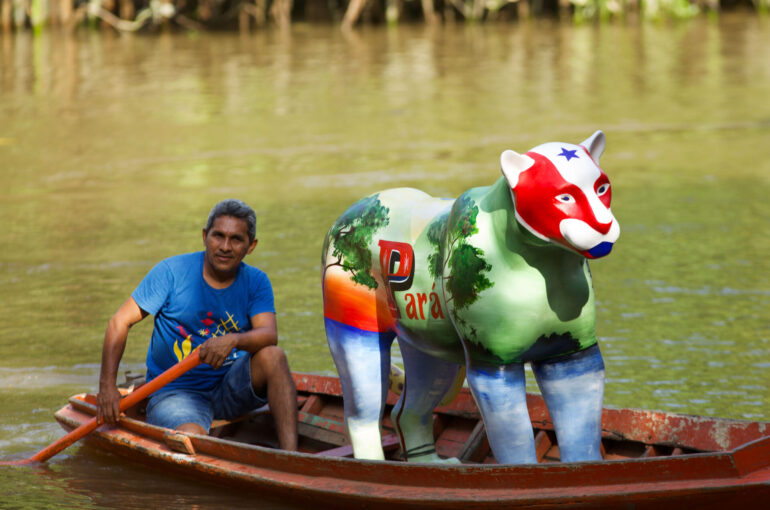
On the rivers of the Amazon, boats carry names that do not go unnoticed. The letters painted on their hulls are filled with color, shadows, landscapes and movement. This craft, known as letter opening, is part of riverine culture and transforms each boat into an artistic canvas that travels daily along the rivers.
It was from this universe that the web series “An Opener of Letters” was created for Jaguar Parade Belém, sponsored by Itaú. Across four episodes, the series follows the creative process of Augusto Amorim, an artist from Marajó Island and resident of Ponta de Pedras, who was invited to paint a Jaguar Parade jaguar, bringing to the sculpture the visual references, colors and symbols of the place where he lives.
The jaguar created by Augusto was named “Amazônia”, but it also received an affectionate nickname from the artist himself: “Princesinha do Marajó”. The work brings together the visual repertoire of the letter opener, a traditional Amazonian craft with more than a century of history, passed down from generation to generation along the region’s rivers.
By bringing this language to sculpture, Augusto translates a historic craft into a new medium, preserving its origins and rhythm while placing it in direct dialogue with the urban landscape.
Episode 1: Roots and Identity
The first episode introduces Augusto Amorim’s journey. When he was still young, he became fascinated by a boat passing along the river, drawn to the colors and details of the painted lettering. The image stayed with him and sparked his interest in learning the craft.
After moving to Ponta de Pedras, his contact with the boatyards was immediate. He began with basic tasks: preparing surfaces, sanding and observing. From the beginning, his goal was clear: to work with the lettering.
When the opportunity to paint came, Augusto accepted it, even with limited resources and simple materials. From then on, the jobs began to multiply. One boat led to another, until letter opening became his main occupation. Through this craft, he built his life, raised his children and came to recognize himself as an artist.
▶ Watch Episode 1 and discover the origins of Augusto Amorim and his relationship with the craft of letter opening.
Episode 2: Gesture and Aesthetics
The second episode follows Augusto’s working process. The lettering painted on boats is not limited to typography. It incorporates landscapes, color combinations and elements of everyday riverine life. Skies, rivers, reflections and transitions of light become integrated into the letters, creating compositions that cover the entire hull.
Before beginning a painting, Augusto observes the space and talks with the person who commissioned the boat. Their preferences influence the choice of colors, while the composition emerges from years of accumulated experience.
The episode also shows how this knowledge is passed down within the family. His children have followed the process since they were young, beginning with simple tasks and eventually learning to paint. In this way, the craft remains active and shared as part of everyday life.
▶ **Watch Episode 2 and take a closer look at the gesture, technique and aesthetics of the letter opener.
Episode 3: Nature and Inspiration
In this episode, the landscape appears as a constant part of Augusto’s work. He paints from what he experiences. Islands, rivers, rocks, palm trees and houses along the water naturally appear in the images he creates. These are scenes from his everyday life that ultimately become paintings.
These elements are also present in the Jaguar Parade jaguar. “Amazônia”, or “Princesinha do Marajó”, brings together fragments of this territory and functions as a visual portrait of the region. The sculpture contains scenes that evoke riverine life and the direct relationship with nature.
Those who look closely at the work can find details that speak of Marajó and, more specifically, of Ponta de Pedras, even without knowing the place.
▶ Watch Episode 3 and discover how the territory becomes image and narrative.
Episode 4: The Complete Jaguar and the Legacy
The final episode presents the finished jaguar and reflects on the continued circulation of this knowledge.
While boats remain, for the most part, on the rivers of the region, the sculpture reaches new spaces and expands the reach of the letter opener’s aesthetic.
Augusto discusses the importance of keeping this craft alive. There was a period when finding lettering painters became increasingly difficult. Today, teaching this knowledge through workshops, trips and cultural projects helps strengthen the practice and spark interest among younger generations.
Augusto Amorim’s participation in Jaguar Parade Belém represents a meeting between tradition and urban art. The jaguar “Amazônia”, also known as “Princesinha do Marajó”, becomes a visual record of a craft that remains active, connected to the territory and constantly evolving.
▶ Watch Episode 4 and discover the completed work, along with reflections on legacy and continuity.
By bringing the craft of letter opening to Jaguar Parade Belém, the project creates a shift in scale and context. A form of knowledge that travels daily along the rivers moves into the urban space while maintaining its visual references, rhythm and territorial origins. This transition was made possible through Itaú’s sponsorship, supporting initiatives that connect art, territory and socio-environmental impact in the region.
Through this encounter, Jaguar Parade Belém becomes a space for the circulation and visibility of cultural practices connected to the territory. “Amazônia”, or “Princesinha do Marajó”, enters the urban landscape as a record of a living craft, passed down through everyday life and sustained through the continuity of practice.
The journey of the work comes full circle at the Jaguar Parade charity auction. Once auctioned, the sculpture generated resources for Onçafari, connecting the artistic gesture with the conservation of jaguars and the ecosystems they inhabit. In this way, Augusto Amorim’s knowledge returns to the territory in another form: art born from the landscape now contributes directly to its preservation.
The result is a work that expands the reach of this knowledge without breaking with its origins, connecting art, territory and memory through a single gesture. This attentive approach to creative processes and the contexts in which art takes place also runs through other initiatives supported by Itaú in Belém, such as the Habitat Project, which you can learn more about on our blog.