
The ROI of Culture: How the Rouanet Law Generated R$25 Billion and Why Your Company Should Be Part of It
The ROI of Culture: How the Rouanet Law Generated R$25 Billion and Why Your Company Should Be Part of It
Cultural Marketing | Art for Pets | Art of Love | ESG – Social Projects | Jaguar Parade | Cause Marketing | Market
Investment in culture in Brazil has long gone beyond simply “supporting the arts” to become a strategic pillar of economic development. Even so, this role is not always clearly reflected in public debate.
Recently, a study by the Fundação Getulio Vargas (FGV) presented figures that confirm what we at Artery see happening every day in the streets: culture is an extraordinary driver of growth.
In 2024, the Rouanet Law generated R$25.7 billion in economic activity in Brazil. But what do these figures mean for the B2B sector and for brands looking to generate real impact?
1. The Multiplier Effect: R$1 Becomes R$7.59
One of the study’s most impressive findings reveals that for every R$1.00 invested through tax incentives, R$7.59 is returned to society.
This return is not abstract. It materializes through consumption, tourism, and services, involving artists, technical crews, suppliers, printers, communications companies, and other local services. The impact goes beyond the cultural sector, activating different production chains and directly contributing to the economies of cities.
At Artery, we turn this multiplier effect into tangible visibility. When we organize a Jaguar Parade or an Art of Love, we create urban destinations that attract people to shopping malls and public spaces, stimulating local commerce and generating value for sponsoring brands.
2. Demystifying Tax Incentives: An Investment with Social Benefits

There is a misconception that the Rouanet Law “takes money away from the government.” The FGV study demonstrates otherwise: for every R$1.00 in tax incentives, R$1.39 returns to public coffers through taxes generated by the economic activity stimulated by cultural projects.
It is an investment that generates both social benefits and public revenue.
For companies, this means that using tax incentives is a financial efficiency strategy. By allocating part of the taxes they owe to projects such as Art for Pets, brands move beyond simply paying taxes and become part of an initiative that supports animal welfare, strengthens partner organizations, and communicates their ESG values directly to the public.
3. Job Creation and Regional Impact
At Artery, this reach becomes tangible through the way each project is developed.
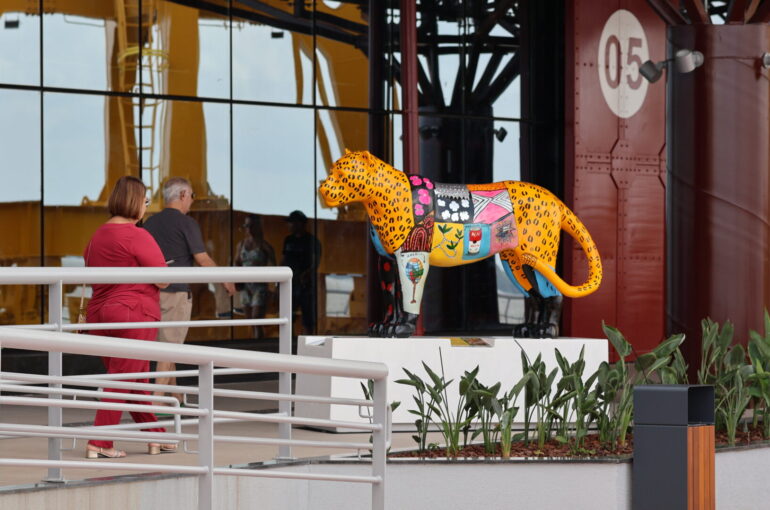
In the Jaguar Parade edition in Belém, for example, the exhibition was produced with professionals from the region itself, from artists to local production, audiovisual, and technical suppliers, including the jaguar sculpture itself, created by an artist from the city.
By working with local talent in each city where our exhibitions take place, we contribute to income generation, the circulation of resources, and the strengthening of the creative economy across different regions of Brazil.
Ver essa foto no Instagram
This movement is reflected in the sector’s data. According to the research, in 2024, the cultural sector supported more than 228,000 jobs, while 85.5% of the suppliers involved in incentivized projects were micro and small businesses, demonstrating the strong regional impact and the ability of culture to distribute opportunities across different parts of Brazil.
4. Why Is Artery the Link in This Chain?
The study points out that Visual Arts have one of the highest Economic Leverage Ratios, generating R$8.47 for every real invested. And this is precisely where Artery excels.
We do not simply offer a cultural project; we offer an engagement platform that:
- Expands access: free, public art without barriers.
- Generates institutional value: connects brands with urgent causes such as wildlife conservation, pet adoption, and mental health.
- Measures results: we transform the economic impact data of the Rouanet Law into exposure and reputation metrics for our partners.
The FGV data is clear: investing in culture through the Rouanet Law is good for Brazil, good for society, and excellent for business.
The year 2026 marks a new era of transparency and efficiency in the sector, and Artery is ready to help your company play a leading role in this transformation.
Is your brand ready to turn these figures into real impact?